April 12, 2026
Save the Princess — A Fruited IPA That Taught Me a Few Things
Setting the Scene
There's something about a brew day that's been living in your head for months. You know the one — that recipe you've sketched out on napkins, tweaked in brewing software at midnight, and talked about to anyone who'd listen. For me, Save the Princess was exactly that beer. A big, fruited IPA loaded with peach and pineapple, built on a pillowy base of Golden Promise and wheat. I'd been planning this one for a while, and when brew day finally landed on April 30th, 2023, it felt like something clicking into place.
This batch carries a little extra weight beyond the recipe itself. It was my first brew back in New Hampshire — a fresh start in a familiar place. It also happened to be batch number ten in my old brewing database, which means it was the final entry before I turned the page on that chapter of record-keeping. There's a poetry to that I didn't plan but can appreciate in hindsight: the last batch in one system, brewed in a new home, reaching for something ambitious.
The weather was cooperating, the equipment was unpacked and ready, and I had ten pounds of peach puree and eighty ounces of pineapple slices sitting on the counter like a tropical still life. It was time to rescue this princess from my imagination and get her into a fermenter.
The Recipe Story: Why This Beer?
Let me walk you through the thinking, because this grain bill tells a story. The backbone is six pounds of Simpson's Golden Promise — one of my favorite base malts for IPAs that need a little more character than your standard two-row. Golden Promise brings this biscuity, slightly honeyed sweetness that plays beautifully with fruit additions. It's a malt that says, I'm here, but I'm not going to shout over your hops.
Then there's four and a half pounds of Briess White Wheat Malt sitting right behind it. That's a significant wheat presence — nearly 37% of the grain bill — and it's intentional. I wanted a beer with body. I wanted that soft, almost pillowy mouthfeel you get from a New England-style IPA, the kind where the sip feels like biting into a cloud. Add in a pound of flaked oats and a third of a pound of torrified wheat, and you're looking at a grain bill that's practically begging to be hazy and full.
The specialty grains are where it gets interesting. A third of a pound each of American Honey Malt and Crystal Light — just whispers of sweetness and complexity. The Honey Malt in particular was a deliberate nod to the peach addition. I wanted the base beer to already be speaking the same language as the fruit, so when ten pounds of peach puree hit the fermenter, it would feel like a conversation rather than a collision.
For hops, I went all-in on El Dorado, and I went single-hop for a reason. El Dorado is one of those varieties that already lives in tropical and stone fruit territory — think candy-like notes of pineapple, mango, and yes, peach. By layering it across the entire boil in escalating additions (starting at 0.4 ounces at 60 minutes and building to 0.8 ounces at flameout), the idea was to create a hop profile that would merge seamlessly with the fruit. Not compete. Not hide. Merge.
And then there's the fruit. Ten pounds of peach puree. Eighty ounces of pineapple slices. For a five-liter batch, that is an absurd amount of fruit. I knew it was aggressive. I wanted aggressive. I wanted this beer to taste like a tropical rescue mission — like someone had dropped you into the most luscious fruit stand you'd ever seen and said, drink your way out. The name "Save the Princess" was supposed to be playful and a little over the top. The recipe matched the energy.
The yeast choice was Imperial A20 — Citrus, their clean California-style ale strain — and I pitched two packets to make sure we had a healthy population for what was going to be a challenging fermentation environment. That much fruit sugar is a lot to ask of your yeast, and I wanted them to hit the ground running.
Brew Day: Sticky, Sweet, and Full of Hope
Let me start with the word I wrote in my own brew notes, because it captures the day perfectly: sticky.
The mash went smoothly enough. With that much wheat and oats in the grain bill, I was prepared for a slow sparge, and it delivered. There's always a moment during a wheat-heavy mash where you're staring at the runoff and thinking, is this going to get stuck? It didn't, but it threatened to. That thick, protein-rich wort coming out of the mash tun looked like liquid gold — opaque, viscous, and promising.
The boil was where the kitchen started to smell incredible. El Dorado at 60 minutes gave the whole room that resinous, citrus-candy aroma, and each subsequent addition just layered on top. By the time I dropped that 0.8-ounce flameout addition, I was standing over the kettle breathing deeply like some kind of hop aromatherapist. The escalating hop schedule meant the boil was punctuated by these little moments of activity — weigh, add, stir, inhale — that kept me engaged for the full sixty minutes.
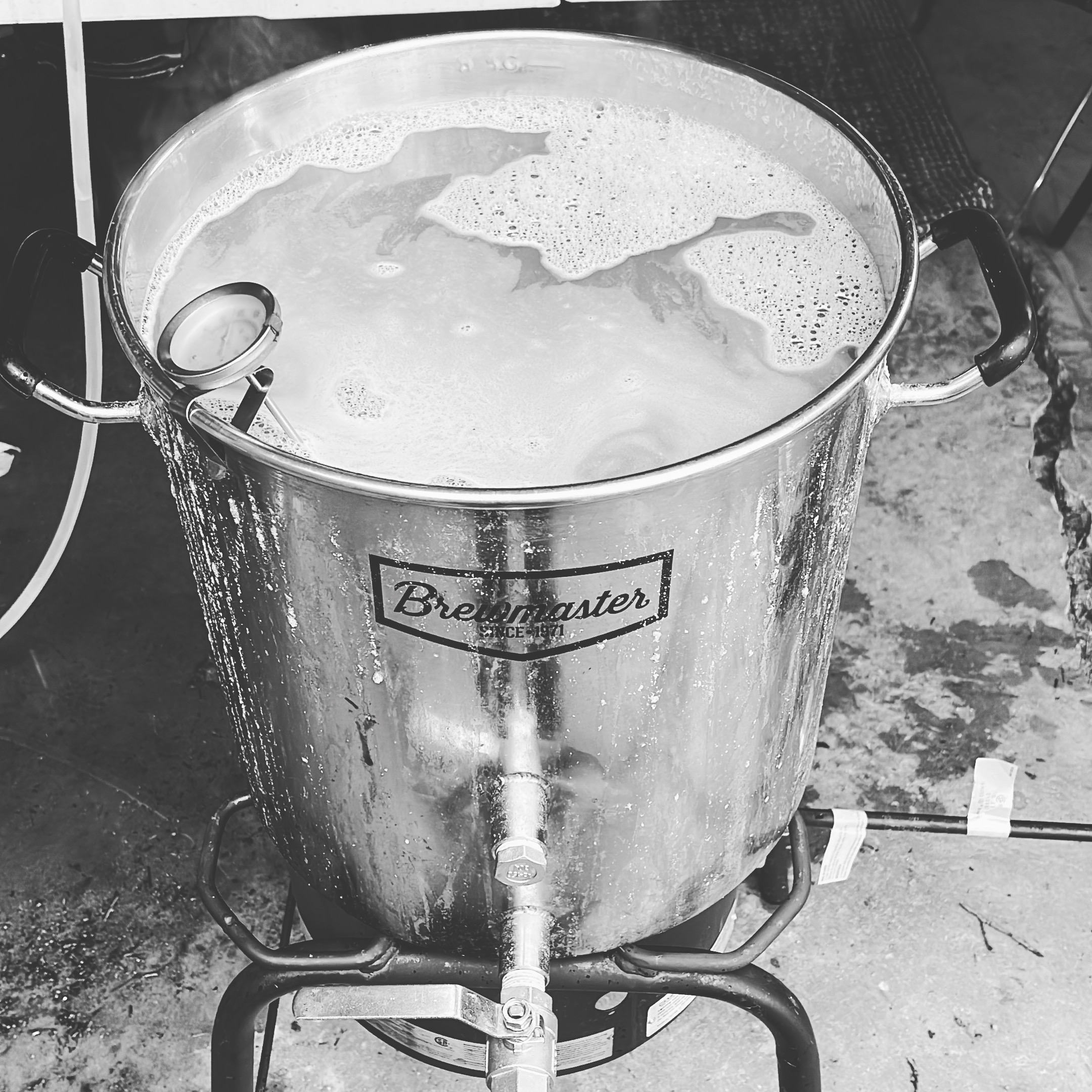
Here's where I have to be honest about the numbers, though. My target OG was 1.074, and I came in at 1.051. That's a significant miss — we're talking about a beer that was supposed to be a muscular 7%+ IPA landing closer to session territory. The combination of a small batch size and that heavy wheat/oat bill probably worked against me, but this is a mashing problem I've had lately, and I'm determined to get to the bottom of it. In the moment, I noted it, shrugged, and moved forward. You can't un-mash a mash.
The fruit additions were their own kind of event. Handling ten pounds of peach puree for a five-liter batch is like trying to fit a king-size comforter into a twin-size duvet cover. It's messy. It's ridiculous. Your hands are sticky, the counter is sticky, somehow the dog is sticky. But you scoop it in, add those pineapple slices, and seal things up knowing that fermenter is absolutely packed with fermentable sugar and flavor potential.
Fermentation & Conditioning
It was spring; I don't have a fermentation chamber or heat/cooling jacket so my estimate is that fermentation ran 68°F for 2 weeks while we let Imperial A20 do its thing. With two packets pitched, activity was visible within twelve hours — a healthy, confident start. The fermentation ran for fourteen days total, and I tried to be patient with it, knowing that all that fruit sugar needed time to be processed.
The final gravity came in at 1.012, which is actually lower than my target of 1.0185. On one hand, that's good news — it means the yeast chewed through more sugar than expected, landing at a clean 5.1% ABV. On the other hand, given that the OG was well below target, the overall attenuation picture is a bit muddled. The beer finished drier than the recipe intended relative to where it started, but with all that residual fruit sweetness in the mix, "dry" is a relative term.
I didn't do any dry hopping on this batch, which is something I've thought about since. The hop schedule was entirely in the boil, and while that gave good bitterness at 46.4 calculated IBUs, I think a dry hop charge of El Dorado might have added the aromatic punch I was ultimately missing in the finished beer.
The Tasting: A Princess in a Sugar Castle
Let me paint you the picture. The pour reveals a slightly hazy, golden-amber beer with a modest white head that fades to a thin ring. It's pretty. Not the opaque juice bomb I was originally envisioning, but attractive in its own right.
The aroma hits you immediately — very fruity, exactly as intended. Peach dominates, with pineapple playing a sweet, tangy supporting role underneath. It smells like a smoothie shop on a summer afternoon. There's a hint of the El Dorado's candy-fruit character in there too, but honestly, the hop aroma is mostly buried under the avalanche of fruit.
The first sip is where things get complicated. It's sweet. A little too sweet, if I'm being honest with myself, and I am. The peach puree and pineapple brought a residual sweetness that sits on the palate and doesn't quite let go. There's fruit flavor in abundance — peach up front, pineapple on the mid-palate, a whisper of biscuity malt underneath — but the balance is tipped firmly toward sugar rather than the bright, punchy, tropical IPA I had in my head. The bitterness from the El Dorado is present but overwhelmed, like a referee trying to manage a game that's already gotten out of hand.
The mouthfeel is medium, which tracks with the grain bill. That wheat and oat backbone did its job — there's a softness here that's pleasant and appropriate for the style. The body is satisfying without being cloying, even if the sweetness pushes it in that direction.
I gave it a 6 out of 10, and I think that's fair. It's drinkable. It's interesting. It's not the beer I set out to make.
What I'd Change Next Time
This is the section where you grow as a brewer, so let's get into it.
Less fruit, more restraint. Ten pounds of peach puree and eighty ounces of pineapple for a five-liter batch was simply too much. I'd cut the fruit by at least forty percent and see where that lands. The fruit should accent the beer, not become the beer.
Add fruit during the whirlpool, not just fermentation. This is the big lesson. Adding all the fruit post-boil during the whirlpool would give me more of the bright, fresh fruit character without as much residual sweetness. The heat would help extract flavor and aroma while driving off some of the heavier sugars. I'd consider splitting the addition — some at whirlpool for flavor, a smaller charge during fermentation for aroma.
Dry hop. An ounce or two of El Dorado as a dry hop would have given this beer the "punch" I was looking for — that aromatic pop when you bring the glass to your nose that says this is an IPA, not a fruit cocktail.
Address the OG miss. Whether that means adjusting my mash process, extending the mash time for that wheat-heavy bill, or simply recalculating for the small batch size, I need to hit closer to my target gravity. A higher OG would have given this beer more alcohol to balance the sweetness and more malt backbone to stand up to the fruit.
Consider a more attenuative yeast. A20 is a solid strain, but with this much fruit sugar, something with a bit more chewing power might have helped dry the beer out where it needed it.
The Takeaway
Here's the thing about Save the Princess: I'm still glad I did it. This was a beer that had been rattling around in my brain for months, and getting it out of my head and into a glass — even an imperfect glass — was worth every sticky, messy minute of brew day. It marked a new beginning in New Hampshire and closed out the old brewing database with something ambitious and unapologetically bold.
Was it too sweet? Yes. Did it miss its gravity target? Yes. Did it teach me more about fruit additions, grain bill design, and the importance of restraint than any recipe I'd read in a book? Absolutely.
The princess didn't need saving, it turns out. She needed editing. And the next time I brew this — because there will be a next time — she's going to be exactly the bright, punchy, tropical IPA I originally dreamed up on those late-night napkin sketches. Sometimes the best batches are the ones that show you exactly what to do differently.
Comments
No comments yet — be the first.
Support the Brewery
Brewery Fund
Help make my brewing dreams come true — every dollar goes toward gear, ingredients, and new experiments.
Powered by Stripe · Secure checkout